Islands: Morocco 2026
“Consider all this; and then turn to the green, gentle, and most docile earth; consider them both, the sea and the land; and do you not find a strange analogy to something in yourself? For as this appalling ocean surrounds the verdant land, so in the soul of man there lies one insular Tahiti, full of peace and joy, but encompassed by all the horrors of the half-known life. God keep thee! Push not off from that isle, thou canst never return!”
– Herman Melville, Moby Dick“If you see a ruin, suspect a treasure.”
– Rumi
Morocco, like so much of the Global South, has its “modern” manifestation. Few foreigners, of course, come for this. They come for the desert or for the old cities for a sliver of authenticity that may be lacking in their home countries. One couldn’t do better in finding this authenticity than seeing the medinas of Marrakesh and Fez. They come across almost as images from an Orientalist fantasy. Their alleys narrow to the point of virtual non-existence. Donkey-carts compete with ill-fed cats for space. Smoke rises from unseeable grills, occluding the sun whose light can scarcely touch the ground below. The lanes seem to eschew mapping; only memory and experience can guide one through them.
One could easily see in these places a setting for mystery, but there is nothing truly mysterious or exotic about them. The medinas, centuries-old, survive as neighbourhoods for the working class (and working poor), urban layouts ill-suited for years of population growth, yet still thriving with their own rhythm. Pregnant with activity and character, the medinas are a chaos of sensory information that gives the traveller everything but calm. Calm, however, can be found. Morocco’s traditional cities seem shaped around a specific spiritual quality: that all exteriors have an interior, that the inner world, that which requires effort to find, is where we can find our own personal truth.
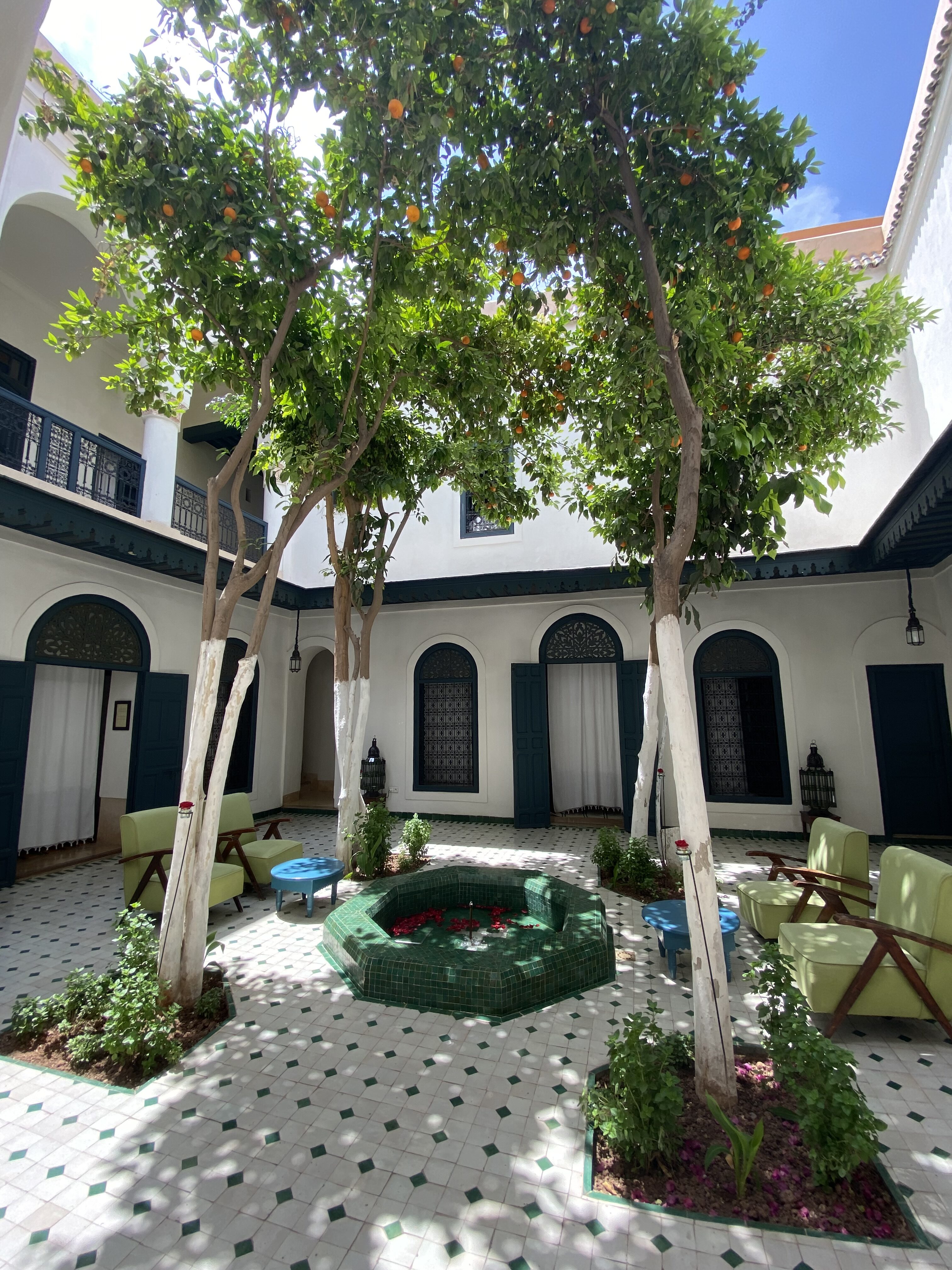
The riads of Morocco speak to this better than anything else. Formerly the homes of merchants and other elites, they appear unimpressive from the outside. Their walls are high, creating a sense of deliberately cultivated seclusion. Their splendour is evident when you pass through the entrance into the courtyard, where lemon trees reach high toward the second story, almost as if seeking an escape, or, perhaps, reminding guests that beyond the walls is the sky and a world greater than the one they inhabit. Sofas are embedded within niches that allow one to witness this enclosed world free from the intensity outside. The tilework is exquisite in its symmetry, bringing you into a form of living where balance and harmony are norms and not just ideals. This is a spiritual ideal as much as an architectural marvel, to create a space cocooned in a much-longed for peace. It isn’t merely you who yearn for this solace. Fellow travellers amongst you gaze out from the riad’s divans in silent contemplation. You realize your longing is hardly unique as you sit amongst fellow sojourners who travel the world in search for a better self, a better soul, a better way of living.
The first day in Morocco, I reminded myself of a quote in Moby Dick where Ishmael talks about the “soul of man” which contains its own island, where peace is surrounded by “all the horrors of the half-known life.” Melville’s words have a bleakness in them. Perhaps in this darkness is a truth, yet in Morocco, thinking of this quote, I recalled other lessons as well. God in Islam has ninety-names, of which two are God Al-Zahir (“The Manifest”) and God Al-Batin (“The Hidden”). What is true of God is true of the universe, and ourselves. Buildings have their own essence. Our actions are guided by specific intentions. Our bodies have a sacred core as unmappable as the medina’s streets, but still known to the Divine if unknown to us.
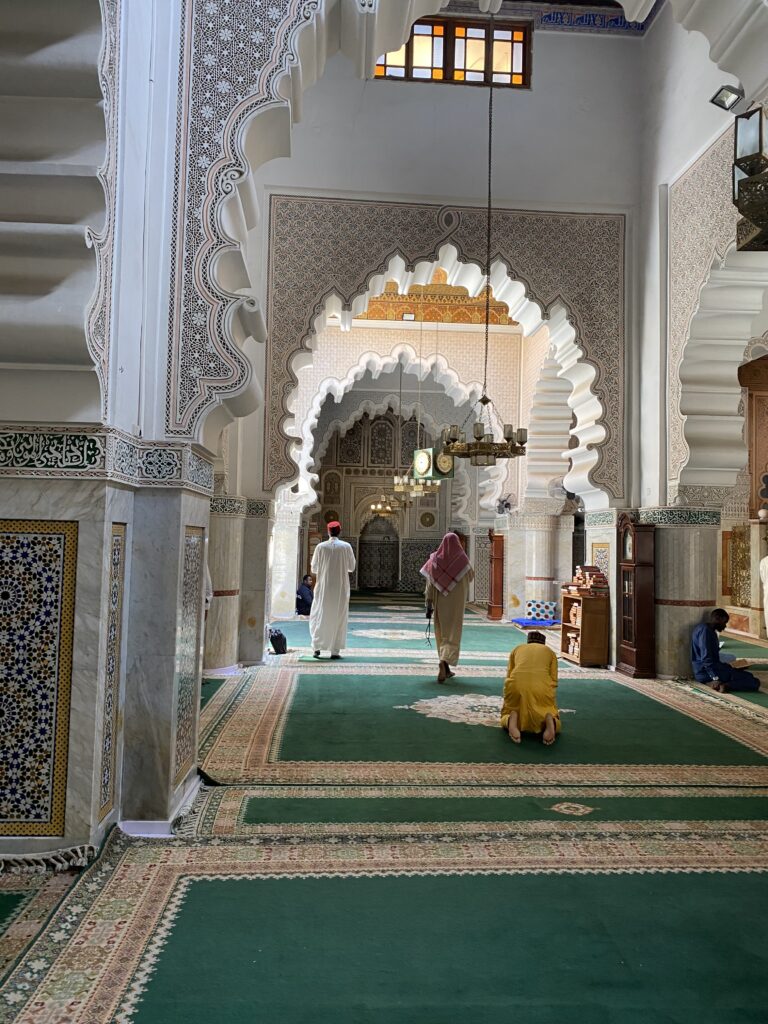
It’s not only in the riads of Morocco where one can see this bifurcation between the exoteric and the esoteric, between what is apparent and what is hidden. The saints of Morocco, the awliya (“Friends of God”), represented this duality better than anyone. They lived lives of virtual invisibility, at least invisible to those uninterested in spiritual wisdom. Herb sellers, lepers, men afflicted with blindness, they were the marginalized and yet they amassed seekers around them. Their names ring out to this day: al-Sabti, al-Sanhaji, al-Qundusi and others. Like the riads, their zawiyas, their mausoleums, are virtually hidden, discoverable only with the aid of guides, like secret gardens appearing in a desert. Wandering the claustrophobic thoroughfares, bartering with men selling rosaries, brewing tea for shopkeepers, fashioning combs out of camelbone, I often wondered: which of these people have that secret light, that rare, purified soul that speaks directly to those hearts that need their voices the most?
I think back to Melville in those streets. Is this sacred core what Melville speaks of? An island adrift? Yet, must it be adrift in horror? Could it not be afloat on a more pleasant sea? Could life be a return to a form of innocence in a paradisical island where the predations of the outside world vanish? And what world exists outside of this peace? Can we find it in ourselves wherever we go–at home, in Morocco, in the courtyards we walk across everyday?
These questions tumble out of me days after leaving Morocco, not with despair but with wonder.